- Company
- Personal project - home automation
- Role
- Designer and builder - defined what a good alert is, hand-reviewed the answer key, designed the results explorer and built the grader with AI
- Duration
- July to November 2026, on the side
- models and settings graded on the same 20 real camera scenes
- 44
- 90th percentile wait, the top score vs the model I picked
- 13.4s → 1.9s
- alerts where a blind reviewer overturned a confident grader answer
- 1 of ~2,000
After deploying ArovyAI (chat) and ArovyMCP, I quickly realized that developing an eval suite was the missing piece that would give us confidence that our bot was answering customer questions effectively and keep us from losing their trust. While that work has PII that's harder to share, I took the same principles and applied it to a problem at home: has Amazon delivered my package yet?! Every time someone walks up to my house, a vision model looks at two camera snapshots and writes a quippy one line alert that Home Assistant sends to my phone. I built an eval suite to choose which model runs, graded 44 models and settings on 20 real scenes from my cameras, and picked the #7 over the #1, because it said nothing false in 60 alerts, answers in under 2 seconds and costs about a dollar a month.
The Challenge
Evals are an essential part of AI development, and they're easy to skip in the process when you're focused on getting a product out the door. In early 2026, I started experimenting with enhancing the notifications I got from my outdoor cameras with the goal of going from "Person detected" to "The eagle has landed! Amazon delivered your package." I started out with Gemini 2.5 Flash which was cheap and fast. Then over the summer Google started cranking out new models monthly and after changing one out I noticed it regressed over the previous one. That's when I knew a more methodical approach to upgrades like this was necessary.
The obvious first stop is public benchmarks, and there are tons of issues with them:
- They're one-dimensional. Trying to get all the facets of an LLM into a single number is sisyphean at best.
- An LLM's effectiveness largely depends on the context you give it and the problems you work on, and in my case that's the imagery from my cameras. No public benchmark can replicate that.
- Anything in a model's training set can be benched for. If the model already knows the answer, of course it's going to get the test right, which is part of why OpenAI stopped reporting SWE-bench Verified. Their audit also found material issues in the tests or problem descriptions of 59.4% of the 138 problems they checked, so even a major public benchmark can have a bad answer key.
- "Benchmaxxed" is now in the dictionary and describes models that bench above their usefulness in practice.
The Solution
As a designer this is the analysis side of UX: did your design actually land? It's the same way I'd use Pendo to figure out friction points in navigation or if we should default to hiding or showing a control.
The idea behind a benchmark is simple: give every model the same test under the same conditions, then grade the answers against a "gold" answer key. My test is 20 real events from our cameras, each a pair of snapshots: 13 where something actually happened and 7 false alarms where the right answer is that nothing's there. I replay each one through the same prompt and settings Home Assistant uses, three times per model to test repeatability and end up with 60 alerts per model.
For each scene I wrote down by hand what's true and what an alert shouldn't claim. For example, in one snapshot I'm heading out before dawn holding an extended leash, and my dog Pepper is hidden behind a parked car:
- Trust is whether a model tells me anything false. For example it should not say that I'm returning home because my back is to the camera.
- Complete is whether it told me everything true that matters. A good alert should work out from the extended leash that the dog is there, even though you can't see her.
- Presentation is the tie breaker, evaluating if the message itself is useful and fun to read. That's a judgment call so I judge it with an LLM in a separate pass.
Those three roll up into one composite score that I then use with speed and cost to decide which model should be my default. I also pick a backup from a second model family in case there is an outage on the primary model.
As the number of models and alerts grew, I developed a deterministic grader to automatically grade the results. Then I had an LLM read the grades and confirm they were correct or flag if they weren't. I'm glad I did because it exposed how messy English language and sentence structure can be, and how hard it can be to measure intent with regex. My first version matched keywords. Is there a dog in the alert? "Pepper Patrols The Driveway" never says dog, so I add Pepper to the list. Negatives are even harder, because on a scene with no dog, saying "dog" is wrong and saying "no dog" is right. Then an alert says "no dog or package", where the "no" applies to a word it isn't next to, while in "no people around, just a dog on duty" it stops at the comma. A dog on a poster or a hoverboard in a bus ad isn't in the scene at all. I was building on quicksand adding exceptions and edge cases.
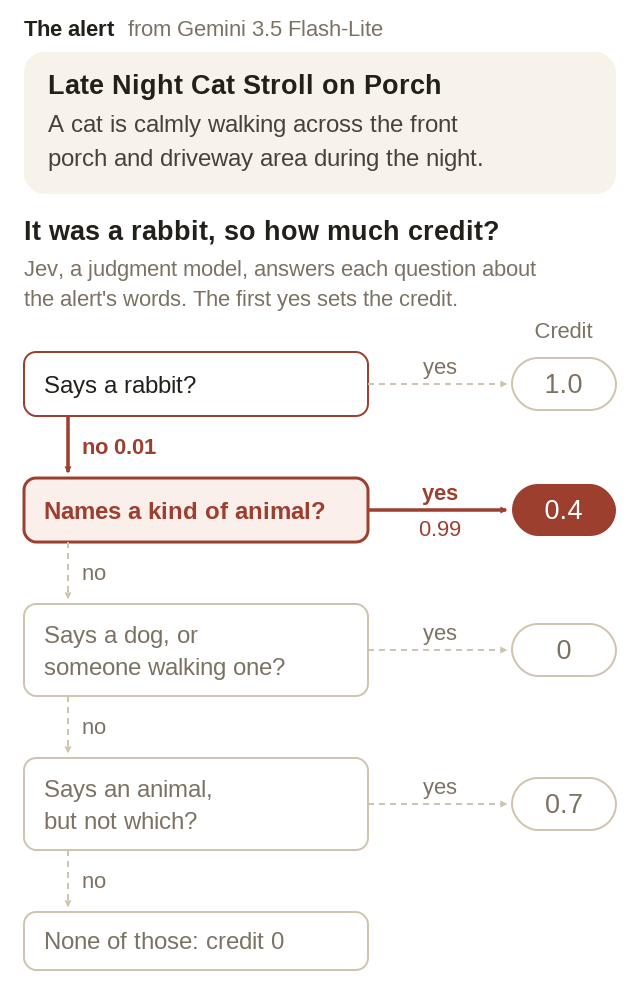
Then TypeSafe's Jev came out. Jev is different from traditional LLMs in that it is a judgment model that returns a probability for a question instead of writing an answer. So I split each claim into narrow yes/no questions: does it say there's an animal, does it say what kind, does it say dog? Anything above 0.7 counts as yes, below 0.3 as no, and anything in the middle means I need to tweak how I'm asking the question to Jev. The credit gets calculated in code, and grading 900 alerts costs about 3.5 cents.
Finally I have an LLM reviewer that I blind so it can't be biased by the model family or order. The reviewer caught a real gap early on: a model read a Safelite van as "Seattle AutoGlass", and Jev treated that as Safelite with full confidence because its list had no option for an unlisted company. After tuning, it overturned one confident Jev answer across about 2,000 alerts. Next I designed a results explorer so I could see the results on both a graph and a table and dig into the responses by case or by model. It has a decision view, a leaderboard with a scatter plot of the trade-offs, a matrix of every model against every scene, and a view of each scene with every model's response and the exact reasons it passed or failed.
Key Decisions & Rationale
- AI doesn't know what is "right" yet: Humans have to write and verify the gold set. As an example I had an LLM draft the gold answer for ten of my twenty scenes and when I reviewed it 4 of the 10 had issues I needed to correct. The worst was a night scene where a "cat" was labeled. At first glance it looks like a cat, especially against the concrete, and I only noticed when a model or two stubbornly called it a rabbit and were losing credit.
- Be careful what information you give your graders. Too little and it can't figure out the name of the dog. Too much and it will start hallucinating the answer it expects into the result it got. When I gave Jev the scene's reference description on an alert that didn't mention a dog, Jev hallucinated that the alert did mention the dog, increasing the probability 0.19 on average.
- Test the model and the prompt together. Fable 5.1 was no better than Fable 5 on the stock prompt, but it jumped to #2 of 44 with a prompt tuned for its model family, and 13 of 18 models gained from tuning. Tuning a prompt for a real job is different from benchmaxxing, but I did it on the same 20 scenes, so I was explicit about trying not to overfit: one change per test, and scenes that weren't allowed to get worse. It's still an area of improvement, and more scenes would show whether the gains hold.
Outcomes
My cameras now run on Gemini 3.5 Flash-Lite, #7 of 44 with a composite score of 0.786, no false statements in 60 alerts, 0.910 on Complete, 1.9 seconds at the 90th percentile and about a dollar a month at our real volume of 1,120 calls. The top of the board shows why one number isn't enough. Gemini 4 Argon scored highest at 0.839, but takes 13.4 seconds at the 90th percentile, which is a long time for a motion alert. Five of the six models above Flash-Lite take over 7 seconds, and the sixth, Fable 5.1 at #2, costs about 31 times more. I chose GPT-6.1 Terra at #13 as the backup. It only fires a handful of times a month, so I cared more about speed than price. The bench changed what I ran as early as August, when doubling from ten scenes to twenty reversed my pick to a model at less than a third of the price. Twenty scenes is still a relatively small sample, so I can't assume this ranking would hold across every situation our cameras see, but it gave me enough to choose a model for our house.
Reflection
I was a little surprised how difficult it was to get a composite score that actually reflected my subjective ranking of the model outputs. A plain weighted average let a polished model hide that it was misleading, and sorting by simply Trust first floated a safe but useless model up the board, so I built a small playground to try formulas against the real results. I landed on cubing Trust and multiplying it by the rest, with Complete counting about twice as much as Presentation. Two false statements in 60 alerts now cost a model about 10% of its score. Complete and Presentation only count on trustworthy alerts, since there's no point scoring how thorough a message is when it's already lying to you.
Moving to Jev also changed how I graded. Initially I was doing pass fail based on attributes (do you see a rabbit, yes or no). That worked, but penalized a model for being honest and unsure. The language constraint would have been difficult to expand to account for this, but with Jev I was able to ask several questions at once and be confident in the answer. Now I use percentages. In the rabbit example I give 1.0 for a rabbit, 0.7 for an animal with no species named, 0.4 for the wrong species, and 0 for a dog or nothing.
You can hand the grading to a system once you've tested it, and you should never hand over the decision of what good looks like.